Where Medical Assistance Costs Go Wrong and How Better Coordination Can Help
Avoidable costs in international medical assistance frequently originate long before an invoice is issued. Unclear coverage authorizations, missing clinical documentation, and fragmented handovers between operational teams generate significant administrative overhead, payment disputes, and delayed settlements.
Controlling operational leakage requires continuous alignment from initial assistance intake through treatment coordination and financial reconciliation.
Where Coordination Gaps Create Cost Leakage
In international care delivery, operational friction usually occurs at three critical handover points:
-
Authorization Ambiguity: Healthcare providers acting without clear scope or benefit caps.
-
Information Asymmetry: Insurers delaying decisions while awaiting standardized medical updates.
-
Reconciliation Friction: Payment teams receiving invoices lacking direct references to the original authorization or agreed rate schedules.
Every break in continuity shifts administrative work downstream. Establishing direct accountability and structured data-sharing early in the case lifecycle prevents compound delays later.
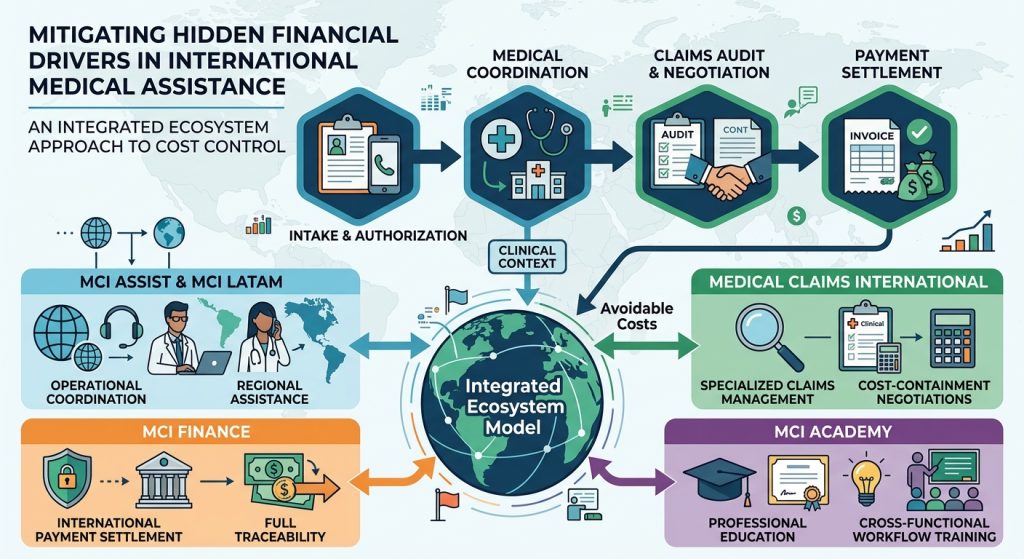
Intake & Authorization ──► Medical Coordination ──► Claims Audit & Negotiation ──► Payment Settlement│[Clinical Context]

Structuring Cross-Functional Operations
To effectively control costs without compromising patient care, three operational functions must continuously inform one another:
-
Medical Coordination: Evaluates clinical appropriateness and manages patient transfer or inpatient status.
-
Claims Management: Audits incoming billing documentation against policy limits, geographical custom-and-reasonable rates, and contractual agreements.
-
Cost Containment: Reviews itemized line items against clinical context to identify overutilization or billing discrepancies.
A financial claim is significantly easier to audit when backed by a complete, real-time clinical history and an unambiguous authorization log.
Case Study: The Integrated Ecosystem Model
To address these systemic friction points, specialized medical assistance networks increasingly utilize integrated ecosystem structures. For instance, MCI Group structures its operations across distinct, highly specialized entities to maintain data continuity throughout the case lifecycle:
| Division | Primary Operational Function |
| MCI Assist & MCI Latam | Operational coordination, regional assistance, and local clinical oversight across global territories and the Americas. |
| Medical Claims International | Specialized claims management, clinical auditing, and cost-containment negotiations. |
| MCI Finance | International cross-border payment settlement linked directly to audited case files to ensure full traceability. |
| MCI Academy | Professional education and staff training focused on cross-functional medical assistance workflows. |
Connecting regional assistance, claims auditing, cross-border payment execution, and workforce training within a unified framework eliminates the administrative silos that typically drive up processing overhead.
Financial Oversight Through Workflow Continuity
Effective financial oversight in international medical management ultimately depends on workflow continuity. When operational, clinical, and financial functions share real-time case data, organizations reduce repeated provider queries, streamline dispute resolution, and establish predictable cost controls.