
Medical Repatriation Explained: When Is Flying a Patient Home Really Necessary?
Medical repatriation may seem simple at first glance. A patient becomes ill or injured abroad, receives treatment, and then returns home. In reality, the process is far more complex. For insurers and medical assistance companies, repatriation is at the same time a medical decision, a logistical operation, and a financial assessment. Timing is critical, as even small changes in a patient’s condition can completely alter the plan. Moving a patient too early can create medical risk, while delaying the transfer can lead to unnecessary hospital costs abroad. The real challenge is identifying the right moment to act.
What is medical repatriation?
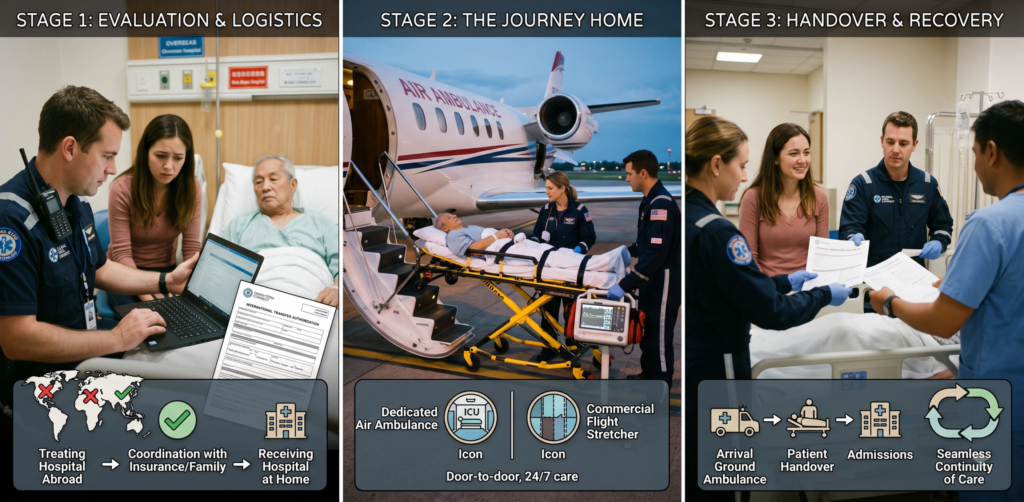
Medical repatriation is the organised transfer of a patient from a foreign country back to their home country or to another suitable medical facility once their condition allows travel. This can be done in several ways, including commercial flights with or without medical escort, stretcher installations on aircraft, ground ambulance transfers before and after the flight, or dedicated air ambulances. The most expensive option is not always the most appropriate, as careful medical planning can often make commercial travel safe and effective.
It is also important to distinguish repatriation from medical evacuation. Evacuation usually occurs when local medical care is insufficient, while repatriation takes place later, once the patient is stabilised and fit to travel.
When does repatriation make sense?
There is no universal rule for repatriation. Each case depends on the patient’s condition, available treatment abroad, expected recovery time, cost of ongoing care, and risks associated with transport. In general, repatriation becomes appropriate when a patient no longer requires acute hospital care but still needs rehabilitation or follow-up treatment. It may also be considered when healthcare costs abroad are significantly higher than in the home country, or when returning home improves continuity of care and family support.
However, timing remains essential. A patient may appear stable in hospital but still be unfit for a long flight due to oxygen needs, pain, fatigue, or the risk of in-flight complications. Stability alone is not enough to justify travel.
The importance of medical assessment
Before any transport decision is made, a detailed medical assessment is required. This involves coordination between the treating physician, the assistance company’s medical team, transport providers, and the receiving hospital. Key questions include whether the patient can sit upright for the journey, whether oxygen or monitoring is required, whether recent surgery affects travel safety, and whether there is a risk of deterioration during flight. These factors determine the most suitable transport option.
A stable patient with minimal needs may travel on a commercial flight with a medical escort, while a patient unable to sit upright may require a stretcher. Critically ill patients who need continuous monitoring or advanced support may require an air ambulance. The goal is not to choose the cheapest option, but to match medical need with the appropriate level of care.
Air ambulance or medical escort?
One of the most important decisions in repatriation is choosing between an air ambulance and a commercial flight with medical support. Air ambulances provide advanced medical care and are essential for high-risk patients, but they are also significantly more expensive. In some cases, however, they are used when not strictly necessary. For example, a patient with a stabilised hip fracture after surgery may not require an air ambulance. With proper assessment, they could travel on a commercial flight with a medical escort, supported by wheelchair assistance and coordinated ground ambulances.
This approach ensures medical safety while significantly reducing costs. The key principle is simple: the best option is the one that meets clinical needs, not necessarily the fastest or most expensive one.
The cost of delaying repatriation
While insurers are often cautious about moving patients too early, delaying repatriation can also increase costs. Hospital stays abroad, especially in private facilities, can be extremely expensive, and even a few extra days can significantly impact a claim. In some cases, additional tests or treatments may no longer be necessary once a patient is fit to travel. This is why active case management is essential. Assistance teams must monitor progress closely, maintain communication with hospitals, and begin planning transport as soon as repatriation becomes likely.
Without early planning, delays can occur in securing flights, medical escorts, documentation, and receiving facilities.
Coordination is key
Repatriation is not a single action but a coordinated process involving multiple parties, including hospitals, physicians, insurers, assistance teams, airlines, ambulance providers, and receiving medical facilities. A breakdown in communication at any stage can delay the entire operation. For example, missing ambulance coordination at arrival, incomplete medical documentation, or lack of hospital confirmation can all disrupt the transfer.
Effective coordination reduces delays, avoids unnecessary hospital days, and ensures a smoother experience for the patient.
Experience in humanized medical repatriation
At MCI Group, through our international medical assistance division MCI Assist , we have built more than three decades of experience in managing complex medical repatriations worldwide.
Over the years, our medical team has been involved in thousands of cases where clinical precision had to be combined with empathy, speed, and careful coordination. This long-standing experience has allowed us to refine a truly humanized approach to patient transport, where medical safety and personal attention go hand in hand.
In many situations, our teams have received direct congratulations from clients and families for the way difficult and sensitive repatriations were handled. These acknowledgements reflect not only technical expertise, but also the importance we place on communication, reassurance, and respect for the patient throughout the entire journey.
What insurers should focus on
For insurers, the quality of the medical assistance provider has a direct impact on claim costs. A strong provider should justify transport decisions based on medical need, not default to the most expensive option.
They should also actively manage cases, communicate with treating doctors, evaluate realistic transport options, and plan post-arrival care. This approach improves both cost control and patient outcomes.
Reducing costs does not mean reducing care. In fact, proper planning often improves safety while preventing unnecessary expenses, such as extended hospital stays abroad without clinical justification.
Balancing Safety and Cost
Medical repatriation sits at the intersection of medicine, logistics, aviation, and insurance. It requires careful judgment, not routine decisions. Sometimes the right solution is an air ambulance. In other cases, a commercial flight with a medical escort is sufficient. The correct choice always depends on the patient’s actual condition, not assumptions or convenience.
When managed properly, repatriation ensures safe return home, continuity of care, and controlled costs, which is the ultimate goal for both patients and insurers.