What ITIC Américas Tells Us About the Future of Medical Assistance in the Americas
Beyond the Business Card: Six Forces Reshaping Medical Assistance in 2026
ITIC Américas 2026 once again confirmed its role as one of the most influential gatherings in the global assistance industry. For insurers, TPAs, and assistance providers, the event serves as a real-time indicator of where healthcare access, costs, and operational demands are heading.
The conversations held throughout the conference painted a clear picture. International healthcare delivery is becoming increasingly complex, medical costs continue to rise, and traditional operating models are under growing pressure. Success now depends on much more than expanding networks or maintaining long-standing partnerships. It requires strategic adaptation.
Here are six key developments shaping the future of medical assistance.
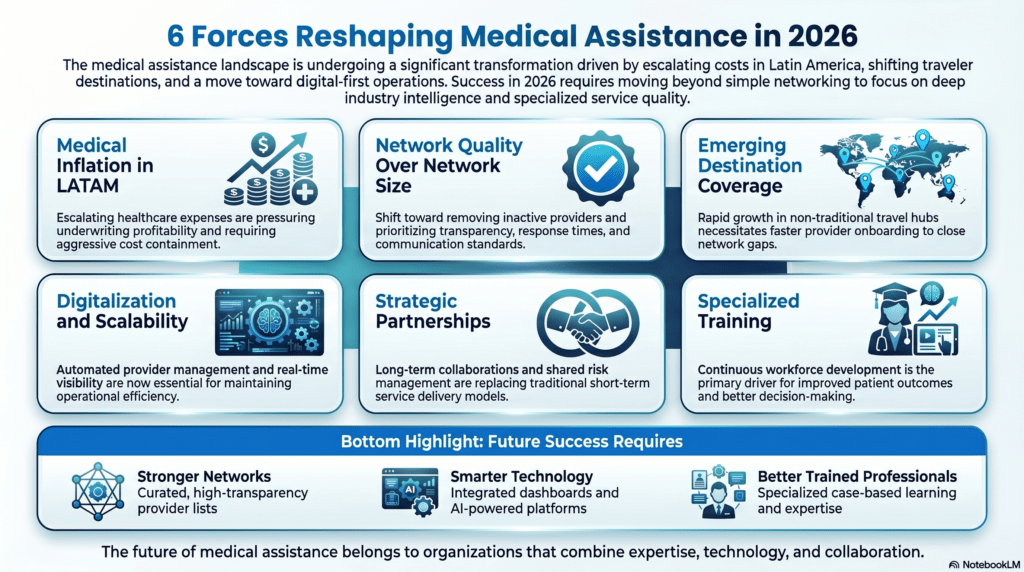
1. Medical Inflation in Latin America Is Testing Profitability
Medical inflation dominated discussions across the region. Healthcare costs are rising at a pace that is putting significant pressure on underwriting results and squeezing margins across the insurance market.
As a result, cost containment has become a strategic priority. Organizations are strengthening local Guarantee of Payment (GOP) management, negotiating direct billing agreements, and developing stronger relationships with healthcare providers. Access to local expertise has become essential for controlling expenses and maintaining competitive pricing.
Insurers that fail to adapt to regional cost dynamics risk seeing their pricing models become increasingly difficult to sustain.
2. Medical Networks Are Being Measured by Performance
The industry’s focus has shifted from network size to network effectiveness.
Large provider directories once served as a symbol of market reach. Today, organizations are reassessing those networks and removing inactive or low-performing providers in favor of stronger partnerships that deliver measurable value.
Three factors now define a high-performing network:
- Pricing transparency through predictable and negotiated rates
- Fast response times that accelerate access to care
- Consistent communication between providers, assistance coordinators, and insurers
The emphasis is increasingly on reliability, efficiency, and patient experience.
3. Emerging Destinations Are Creating New Coverage Challenges
Global travel patterns continue to evolve. Travelers are venturing beyond traditional destinations into secondary cities, remote tourism hubs, and emerging markets where established healthcare networks remain limited.
This shift has created coverage gaps that can quickly become operational challenges during medical emergencies.
To keep pace, assistance companies are accelerating provider identification, vetting, and onboarding processes. Organizations that can rapidly establish trusted medical partnerships in new destinations will be better positioned to support travelers wherever they go.
4. Digitalization Has Become a Core Operational Requirement
Digital transformation was once viewed as a competitive advantage. Today, it has become a fundamental business requirement.
Growing case complexity, expanding provider networks, and increasing cost pressures demand greater visibility and control. Digital tools allow organizations to monitor medical spend in real time, track case progression, and streamline provider management.
By automating routine processes, assistance companies can manage larger case volumes while maintaining service quality and operational efficiency.
For many organizations, digitalization is now the foundation of sustainable growth.
5. Strategic Partnerships Are Replacing Transactional Relationships
The complexity of international healthcare and medical logistics requires deeper collaboration across the assistance ecosystem.
Insurers, assistance providers, and healthcare partners are increasingly working together through long-term strategic alliances that support shared objectives and coordinated decision-making.
This trend was reflected in recent discussions with members of the International Assistance Group (IAG), where the focus centered on integrated service models and collective solutions to industry-wide challenges.
Stronger partnerships improve operational coordination, strengthen cost management efforts, and enhance the overall patient journey.
6. Specialized Training Is Becoming a Risk Management Priority
Industry challenges are growing more complex, and the people managing medical cases must be equipped to respond effectively.
Assistance coordinators routinely make decisions in fast-moving situations involving multiple stakeholders, cultural differences, healthcare systems, and financial considerations. Continuous education helps professionals navigate these challenges with greater confidence and accuracy.
At MCI Group, specialized training remains a central component of risk management. Through the MCI Academy, professionals are exposed to real-world scenarios that strengthen decision-making, improve operational performance, and contribute to better patient outcomes.
As global healthcare becomes increasingly interconnected, expertise remains one of the industry’s most valuable assets.
“As the industry becomes more complex, the skills of assistance coordinators must evolve. Our focus on case-based learning and specialized training through the MCI Academy is a key driver of better patient outcomes, stronger operational performance, and effective cost management in a challenging global environment.”
Looking Ahead
The challenges facing the assistance industry in 2026 are significant. Medical inflation, expanding travel patterns, and digital transformation continue to reshape the operating environment. At the same time, these developments are creating opportunities for organizations willing to evolve.
The direction forward is becoming increasingly clear. High-value provider networks will outperform oversized directories. Digital capabilities will drive scalability and visibility. Strategic partnerships will strengthen resilience. Professional development will play a larger role in managing risk and delivering quality care.
For industry leaders, the key question is no longer whether change is coming. The real question is how effectively their organizations are preparing for it.