Veritas Global and MCI Group Unite to Deliver an Intelligence-Led Protection System for the 2026 World Cup in Mexico
Index
- A New Standard for Global Assistance During the 2026 World Cup
- Operating as a Single Integrated System
- Addressing the Security Gaps Beyond Official Venues
- Moving Beyond Reactive Insurance Models
- Secure Transportation and Geofenced Movement Protocols
- Specialized Medical Stabilization and Evacuation Capabilities
- 24/7 Global Coordination with Regional Expertise
- A Human-Centered Model for Modern Risk Environments
A New Standard for Global Assistance During the 2026 World Cup
The 2026 FIFA World Cup will bring unprecedented international movement into Mexico. Millions of travelers, corporate delegations, sponsors, media teams, athletes, and executives are expected to move across major host cities including Mexico City, Guadalajara, and Monterrey. While the event presents extraordinary opportunities, it also introduces complex operational and security challenges that require a far more advanced approach to traveler protection.

The collaboration between Veritas Global and MCI Group represents a fundamental shift from fragmented assistance services toward a unified, intelligence-led protection system. Rather than separating security, medical response, logistics, and crisis coordination into disconnected functions, this partnership integrates them into a single operational framework designed to reduce exposure before incidents occur.
This approach is especially relevant in Mexico’s evolving risk landscape. Public security efforts surrounding official venues will be extensive under initiatives such as Plan Kukulkan. Stadiums and designated fan zones are expected to receive concentrated law enforcement and military support. However, the greatest vulnerabilities are likely to emerge outside these protected environments, particularly during movement between airports, hotels, transportation corridors, and event venues.
For organizations operating during the tournament, risk management can no longer rely solely on reactive support models or conventional travel insurance. Clients require continuous situational awareness, rapid intervention capability, and coordinated operational oversight that follows travelers throughout their entire journey.
The Veritas Global and MCI Group collaboration has been designed precisely for this environment. By combining strategic intelligence with operational medical and security capabilities, the partnership creates a comprehensive system focused on protecting people where they are most exposed.
Operating as a Single Integrated System
One of the most significant strengths of the Veritas Global and MCI Group partnership is the integration of strategy and execution into a unified operational model.
Veritas Global contributes strategic oversight through advanced safety management, geopolitical analysis, threat intelligence, and the Veritas Global Proprietary Intelligence Methodology (VGPIM). MCI Group contributes international medical assistance, field coordination, emergency response, and operational logistics capabilities across multiple regions.
Together, these functions operate as a single ecosystem rather than parallel services.
This integrated structure allows intelligence monitoring to directly influence operational decision-making in real time. If threat indicators begin to escalate near a transportation corridor, hotel district, or venue perimeter, intelligence teams can immediately coordinate with medical response teams and secure transportation assets to adjust traveler movement before exposure increases.
This coordination significantly reduces response times during dynamic situations. Instead of waiting for an incident to occur before activating assistance protocols, the system continuously evaluates environmental conditions and proactively adapts operations based on evolving risks.
For clients, this creates a much higher level of continuity and reliability. Security monitoring, medical intervention, evacuation planning, and traveler communications are no longer isolated services managed through separate providers. They function together through centralized oversight designed to support rapid decision-making during high-pressure conditions.
The result is a comprehensive duty of care model capable of supporting organizations operating in fast-changing environments during one of the world’s largest international events.
Addressing the Security Gaps Beyond Official Venues
Security planning for the 2026 World Cup will understandably prioritize stadiums, official fan zones, and key infrastructure sites. Mexican authorities are expected to deploy significant resources around these areas through Plan Kukulkan and related federal initiatives.
However, the highest operational vulnerabilities often emerge outside heavily protected spaces.
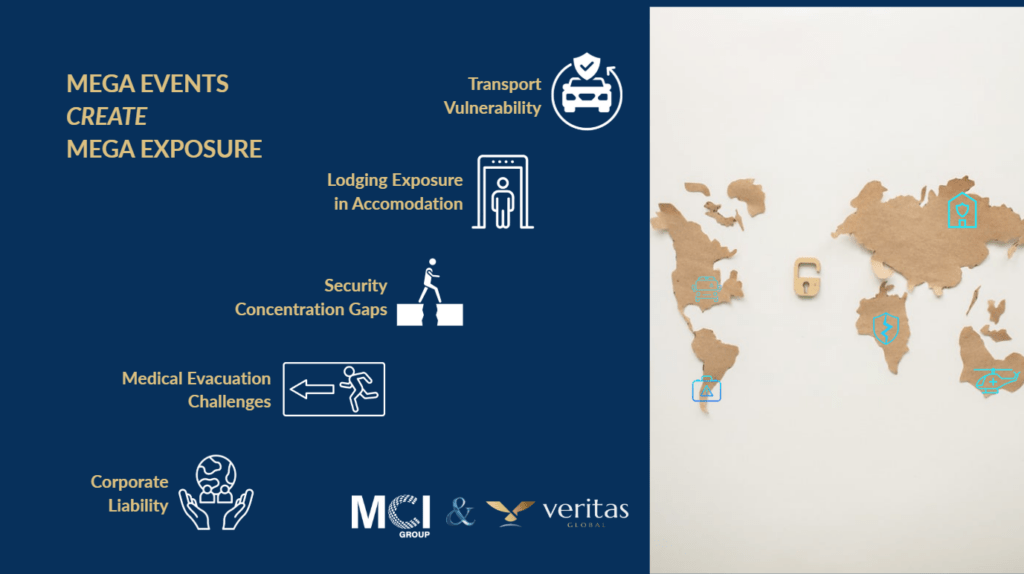
Transit routes between airports, hotels, restaurants, training facilities, and stadiums create what security professionals frequently identify as “vulnerability windows.” These are periods when travelers are moving through less controlled environments where criminal opportunism, localized instability, and infrastructure disruptions become more difficult to predict.
The Veritas Global and MCI Group collaboration specifically focuses on these operational seams.
In cities such as Guadalajara and Monterrey, cartel fragmentation has created increasingly decentralized criminal dynamics. Rather than operating under singular structures, multiple competing groups now influence localized territories and transportation corridors. This creates what many analysts describe as a contained volatility environment where incidents can escalate quickly and unpredictably near otherwise stable commercial districts.
Traditional assistance models are not structured to manage this level of operational fluidity. Static travel advisories or generic security recommendations cannot adequately address rapidly changing conditions on the ground.
The Veritas-MCI system is designed to continuously monitor threat indicators surrounding traveler movement. If intelligence teams identify disruptions such as narcobloqueos, protest activity, criminal incidents, or emerging instability near designated routes, secure transport teams can immediately reroute movements while maintaining communication with operational command centers.
This level of adaptability becomes particularly important during a global event where infrastructure strain, traffic congestion, and increased public concentration may create additional exposure points across urban environments.
By concentrating on the spaces between protected locations, the partnership addresses the areas where travelers are statistically most vulnerable.
Moving Beyond Reactive Insurance Models
Many traditional travel risk programs remain heavily dependent on insurance-based assistance structures. While insurance remains important, these models are inherently reactive. Support mechanisms are frequently activated only after a crisis, injury, theft, or disruption has already occurred.
In Mexico’s operating environment during the World Cup, this approach presents limitations.
Many standard policies include exclusions related to cartel activity, civil unrest, or declared conflict conditions that may complicate claims or reduce operational support during complex incidents. Organizations relying solely on insurance frameworks may discover critical coverage limitations precisely when rapid intervention becomes necessary.
The Veritas Global and MCI Group collaboration moves beyond this reactive model by emphasizing proactive operational risk mitigation.
Through the Veritas Global Proprietary Intelligence Methodology, threat monitoring becomes an active component of daily movement planning and traveler protection. Intelligence teams continuously assess local developments, transportation conditions, criminal activity patterns, and regional escalation indicators that may affect client operations.
This proactive capability allows teams to avoid threats before they directly impact travelers.
For example, if intelligence identifies increased risk along a planned transit route due to criminal roadblocks or narcobloqueos, movement plans can be adjusted immediately. Travelers may be redirected through alternative secure corridors before encountering the disruption itself.
This operational philosophy fundamentally changes the role of assistance services. Protection is no longer limited to post-incident response. It becomes an ongoing process of anticipation, prevention, coordination, and controlled mobility management.
For organizations responsible for executive teams, VIP delegations, sponsors, media personnel, or international staff, this proactive structure significantly strengthens overall duty of care responsibilities during high-risk periods.
Secure Transportation and Geofenced Movement Protocols
Ground transportation remains one of the most critical components of traveler security in Mexico. During large-scale international events, transportation systems often become primary exposure points due to congestion, opportunistic criminal activity, and inconsistent vetting standards among local providers.
The Veritas Global and MCI Group partnership addresses this risk through highly controlled transportation protocols.
The system mandates the use of pre-arranged executive transportation services operated by vetted drivers and approved providers. Street-hailed taxis and unverified transportation options are strictly prohibited due to their documented association with express kidnapping, robbery, and targeted criminal activity in several urban areas across Mexico.
Secure transportation protocols are integrated directly into the broader intelligence and operational framework. Drivers, routes, timing, and movement plans are continuously coordinated through centralized oversight systems.
An additional layer of protection is provided through geofenced movement management.
Travelers are guided within designated “Green Zones” consisting of approved Tier 1 hotels, controlled venues, vetted restaurants, secure medical facilities, and authorized transportation corridors. These secure perimeters are continuously evaluated and adjusted according to real-time intelligence conditions.
If environmental risks shift within a city sector, geofencing protocols can immediately restrict movement into affected areas while redirecting travelers toward safer operating zones.
This model allows organizations to maintain operational continuity while minimizing unnecessary exposure to unstable environments.
For international travelers unfamiliar with local risk dynamics, these structured movement protocols provide both safety and operational clarity throughout the duration of the tournament.
Specialized Medical Stabilization and Evacuation Capabilities
Medical preparedness will play a critical role during the 2026 World Cup due to the extraordinary pressure expected on local healthcare systems and emergency services.
High visitor volumes across multiple host cities may strain ambulance availability, emergency room capacity, and response coordination timelines. During major international events, even well-developed healthcare systems can experience delays and operational bottlenecks.
The Veritas Global and MCI Group collaboration addresses this challenge through specialized medical stabilization and evacuation capabilities designed to function independently from overloaded public systems when necessary.
The partnership utilizes pre-cleared aeromedical evacuation corridors and vetted healthcare networks to support rapid medical intervention across operational areas.
In the event of a medical emergency, the system is structured to provide on-site stabilization within minutes through coordinated local response teams. From there, patients can be transferred through secure corridors toward advanced cardiac, trauma, or specialty treatment facilities within a targeted 75-minute operational window.
This level of preparedness becomes particularly important for organizations managing executive travel, corporate delegations, aging VIP populations, or personnel with pre-existing medical considerations.
Medical operations are fully integrated with intelligence and transportation coordination systems. If environmental conditions affect route safety or facility accessibility, operational teams can rapidly adjust transfer plans without disrupting continuity of care.
The integration of medical assistance with security oversight creates a stronger and more resilient response capability during complex or rapidly evolving incidents.
24/7 Global Coordination with Regional Expertise
Large-scale international events require continuous operational visibility across multiple time zones, languages, and jurisdictions. Delays in communication or fragmented coordination structures can significantly affect response effectiveness during critical incidents.
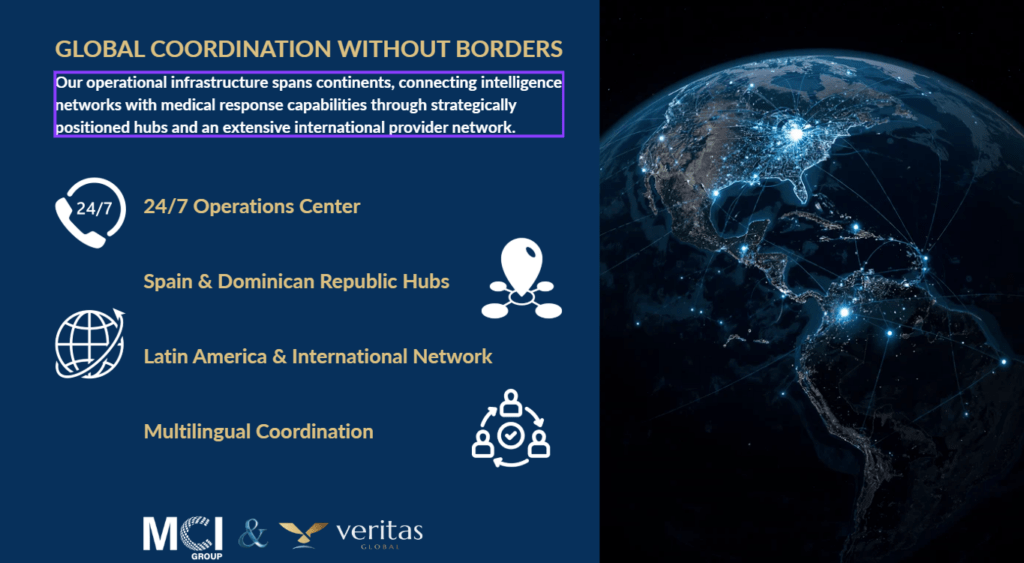
The Veritas Global and MCI Group partnership operates through a 24/7 global support framework supported by regional hubs across four continents, including a dedicated Latin American coordination center in Puerto Plata with MCI Latam.
This global structure ensures that local expertise is continuously supported by international strategic oversight and operational continuity.
Regional teams maintain direct familiarity with local infrastructure conditions, cultural dynamics, healthcare capabilities, transportation networks, and emerging threat environments throughout Mexico and the broader Latin American region.
At the same time, global coordination centers maintain continuous operational monitoring, executive reporting, intelligence analysis, and escalation management support.
Multilingual crisis coordination is another essential component of the system. During high-pressure situations, communication accuracy becomes critical. Continuous multilingual support allows travelers, organizational leadership teams, medical providers, transportation personnel, and security coordinators to operate within a unified communication structure without delays caused by language barriers.
This round-the-clock coordination model ensures that support remains consistent regardless of location, time zone, or incident complexity.
For organizations managing international teams during the World Cup, this operational continuity provides confidence that assistance remains available at every stage of movement and response.
A Human-Centered Model for Modern Risk Environments
The collaboration between Veritas Global and MCI Group reflects a broader evolution in global assistance and duty of care strategy.
Modern operating environments require more than isolated security services, insurance products, or emergency hotlines. Organizations now face increasingly dynamic risk conditions where safety, mobility, intelligence, medical readiness, and operational continuity must function together in real time.
This partnership transforms assistance from a fragmented service structure into a comprehensive, intelligence-led protection system centered around people rather than isolated incidents.
By integrating strategic intelligence, secure transportation, proactive threat monitoring, medical stabilization, evacuation planning, and multilingual crisis coordination into a single operational framework, the Veritas-MCI model addresses the realities of operating in high-exposure environments such as Mexico during the 2026 World Cup.
Most importantly, the system is designed around the moments when travelers are most vulnerable. The focus is not limited to protected venues or post-incident response. It extends to the full movement ecosystem surrounding every traveler, executive team, and international delegation.
For clients navigating the complexities of the 2026 World Cup environment, this collaboration provides more than assistance. It delivers operational confidence, continuity, and protection built around the realities of modern global mobility.