Medical Bill Negotiation vs. Auditing: Where Do the Biggest Healthcare Savings Come From?
Meta description: Medical bill auditing and negotiation both reduce healthcare claims costs in different ways. Discover how insurers can combine both for stronger cost containment.
A €50.000 hospital invoice lands on the desk. For an insurer or assistance company managing an international medical claim, the instinct is simple: reduce the amount. The hospital is contacted, discussions begin, and eventually the provider agrees to a 30% reduction. The invoice drops to €35.000. A €15.000 saving. Not bad.
But one question should have come first: Was the €50.000 bill correct in the first place?
That distinction sits at the center of healthcare cost containment. Medical bill negotiation and medical bill auditing are often treated as if they do the same job. They do not. Negotiation determines what will be paid. Auditing determines what should have been charged. When claims are large or complex, mixing these up leads to avoidable cost.
At MCI Group, through our extensive international provider network and our long-standing experience in cost containment via Medical Claims International (a company operated in Spain since 2002), we consistently see how this distinction directly impacts outcomes. By combining structured auditing with strong provider relationships, we are able to significantly reduce costs for our clients beyond what negotiation alone can achieve.
Medical bill auditing: establishing the real value of the claim
Medical bill auditing is the structured review of an invoice, its supporting medical records, and the pricing applied. It goes far beyond checking whether a total looks high. A proper audit reviews duplicate charges, incorrect quantities, mismatches between invoice and clinical documentation, coding issues, medication and supply billing, ICU and room charges, treatment dates, length of stay, and clinical justification.
It also identifies charges that fall outside reasonable local or provider benchmarks. The goal is not only to find errors but to establish a defensible baseline for the claim. Before any negotiation begins, the question is whether the €50.000 figure is valid at all.
In our experience at MCI Group and Medical Claims International, this audit-first approach is where a substantial portion of savings is often unlocked. By identifying non-payable or incorrectly billed items early, we ensure that clients are not negotiating discounts on amounts that should never have been included in the first place.
Medical bill negotiation: agreeing what will be paid
Once the claim has been reviewed, negotiation begins. Medical bill negotiation is the process of reaching an agreed settlement with the provider. This can include direct discounts, network rates, package pricing, prompt payment terms, settlement agreements, or adjustments to high-cost items.
It is especially important in out-of-network and international cases where no fixed pricing exists. Outcomes often depend on local knowledge, provider relationships, and commercial leverage. Two organizations may review the same invoice and reach very different results based on how well they understand the market and the provider.
Here again, MCI Group’s extensive international provider network plays a key role. Over years of collaboration with hospitals and medical providers across multiple countries, we have built strong relationships that allow us to negotiate effectively and consistently achieve meaningful reductions for our clients, particularly in complex or high-cost cases.
“Is it correct?” and “What will we pay?” are different questions
The difference is simple but critical.
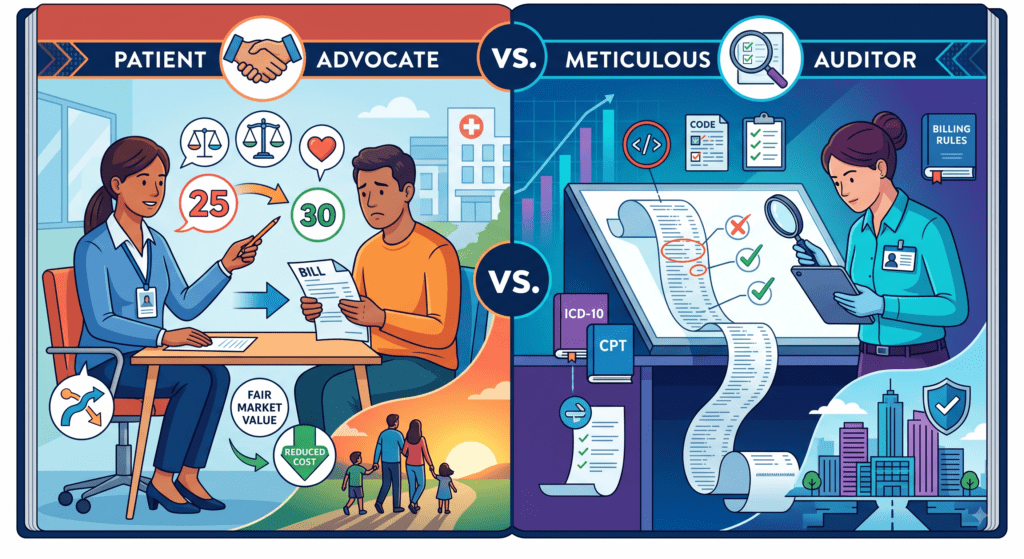
Auditing asks: Is this charge valid, documented, and reasonable?
Negotiation asks: What price can be agreed for the valid amount?
These questions work together, but not at the same time. The order matters. Audit first. Negotiation second. Negotiating an unverified invoice can still produce a discount while leaving unnecessary costs in place. A reduction applied to incorrect charges still results in avoidable spend.
Where medical bill auditing creates savings
Audit savings come from identifying and correcting issues before any discount is applied. These include duplicate charges, unsupported services, incorrect quantities, and documentation gaps. They also include clinical inconsistencies such as unusually long hospital stays, excessive testing, or treatment patterns that do not align with the medical record. Coding and billing errors can also significantly affect total cost. In many cases, auditing also highlights pricing that is far above expected benchmarks. These adjustments change the claim value before negotiation even begins.
At MCI Group this is a core strength developed over more than three decades of experience in healthcare cost containment. Our teams specialize in identifying these discrepancies early, ensuring that clients benefit from a fully validated claim before any commercial discussions take place.
The €50.000 claim: why a smaller discount can deliver better results
Consider a simplified example. The original invoice is €50.000. A negotiation-only approach achieves a 30% discount, reducing the final amount to €35.000. The saving appears strong at €15.000.
Now consider an audit-first approach. The review identifies €4.000 in duplicate or unsupported charges and €3.000 in billing discrepancies. The validated claim becomes €43.000. A 25% negotiation is then applied, resulting in a final amount of €32.250.
The result is clear:
- 30% discount outcome: €35.000
- 25% discount after audit: €32.250
The smaller discount produces a better financial result because the starting point is more accurate. This is exactly the type of outcome we regularly achieve at MCI Group, where combining structured auditing with strong provider negotiation leads to significantly improved savings for insurers and assistance companies compared to negotiation-only approaches.
Why percentage savings can be misleading
Large percentage discounts often look impressive but do not always reflect true cost control. A high reduction applied to an inflated invoice can still result in higher spend than a smaller reduction applied to a validated claim.
A more accurate view separates:
- Gross billed amount
- Audited or validated amount
- Negotiated amount
- Final payable amount
This makes it possible to see where savings actually come from and how much cost was prevented rather than simply reduced.
Where medical bill negotiation adds value
Negotiation remains essential once the claim has been validated. It is particularly effective in high-cost hospitalizations, complex procedures, international cases, and out-of-network claims where pricing is flexible.
Success depends on both technical understanding and market knowledge. Claims expertise identifies what can be challenged. Commercial expertise determines what can realistically be achieved with a provider even in challenging negotiation environments.
Audit first. Negotiate second.
The most effective process follows a clear sequence:
Medical documentation → Bill audit → Pricing validation → Negotiation → Settlement → Payment
Each step strengthens the next. Audit provides evidence. Benchmarking provides context. Negotiation converts both into a final agreed cost. Without audit, negotiation relies on assumptions. With audit, negotiation is based on facts.
Provider networks and their impact on cost
Provider networks add another layer to cost control. Strong networks can establish agreed pricing before treatment, improve transparency, support direct billing, and reduce the need for retrospective negotiation. They also improve access to clinical information and strengthen long-term commercial relationships with providers. In many cases, the most effective savings happen before the invoice is created. Directing patients to appropriate providers with known pricing structures can reduce cost more effectively than later negotiation.
This is a key advantage of MCI Group’s extensive international provider network, which allows us to influence cost at an earlier stage of the care journey and deliver more predictable, controlled outcomes for clients.
From reactive to proactive cost control
Healthcare cost containment typically operates at three levels.
Reactive: The invoice arrives and is negotiated.
Analytical: The claim is audited and validated before negotiation.
Proactive: Networks, pre-authorization, and case management influence cost during or before treatment.
Each level changes the outcome. Reactive control focuses on reducing the bill. Analytical control focuses on validating it. Proactive control focuses on preventing unnecessary cost from entering the system. These are not competing approaches. They are connected layers.
So where do the biggest savings come from?
There is no single answer. Auditing can uncover significant errors and unsupported charges. Negotiation can reduce legitimate costs. Provider networks and case management can prevent unnecessary spending before it occurs.
What is consistent is that auditing and negotiation solve different problems. Auditing ensures the claim is correct. Negotiation ensures the final price is acceptable. Together with provider management and proactive controls, they form a complete cost containment system. The objective is a correct, reasonable, and defensible final claim cost.
At MCI Group, supported by decades of experience through Medical Claims International and strengthened by our international provider network, we consistently demonstrate that the greatest savings are achieved through the integration of all these elements.